
When Images Become Easy, Judgment Becomes Everything

In a previous article, I wrote that AI will not kill cinema, but may quietly erode the conditions that make cinema worth defending in the first place. I was not arguing for nostalgia, nor against technology as such. I was trying to describe a real misalignment between two different logics: one rooted in intention, constraint, collaboration, and consequence, the other in speed, scale, approximation, and optimization. That tension has not disappeared. But it is no longer the only question worth asking. The more difficult question is whether AI can enter filmmaking without quietly teaching filmmaking to think like a machine.
If anything, it is where the more difficult story begins.
Because the question is no longer whether AI and filmmaking clash. Of course they do. The more interesting question is whether that clash can be made productive without simply allowing one side to dissolve the values of the other. Put differently, the challenge is not to ask whether AI can enter filmmaking. It already has. The real challenge is to determine under what conditions it can serve cinema without quietly hollowing it out from within.
That distinction matters because much of the public conversation on this subject still moves too quickly between two equally unsatisfying positions. On one side are the evangelists, who present AI as a liberation from friction, cost, and limitation, as though the burdens of production had merely been obstacles standing in the way of pure creativity. On the other are the purists, who treat every technical incursion as a threat to artistic seriousness, as though cinema had always existed in some protected state of human purity. Neither view is convincing, because both are too simple for the moment we are actually in.
Filmmaking has never been pure. It has always been technical, industrial, collaborative, and shaped by its tools. But it has also never been reducible to its tools. That is why the current moment feels so unstable. AI does not simply introduce another instrument into the workshop. It introduces a different operational logic, one that is often indifferent to the very forms of resistance through which artistic intention becomes legible. And yet resistance itself is not something cinema can simply discard.
Friction has always had a deeper function in filmmaking than many contemporary narratives allow. It is not merely an inconvenience. It is often the place where vague intention hardens into a real decision. It is where collaboration stops being an ideal and becomes a negotiation. It is where the limits of time, money, space, bodies, weather, and material force filmmakers to choose what matters most. Remove all friction, and you do not automatically arrive at freedom. You may just as easily arrive at drift.
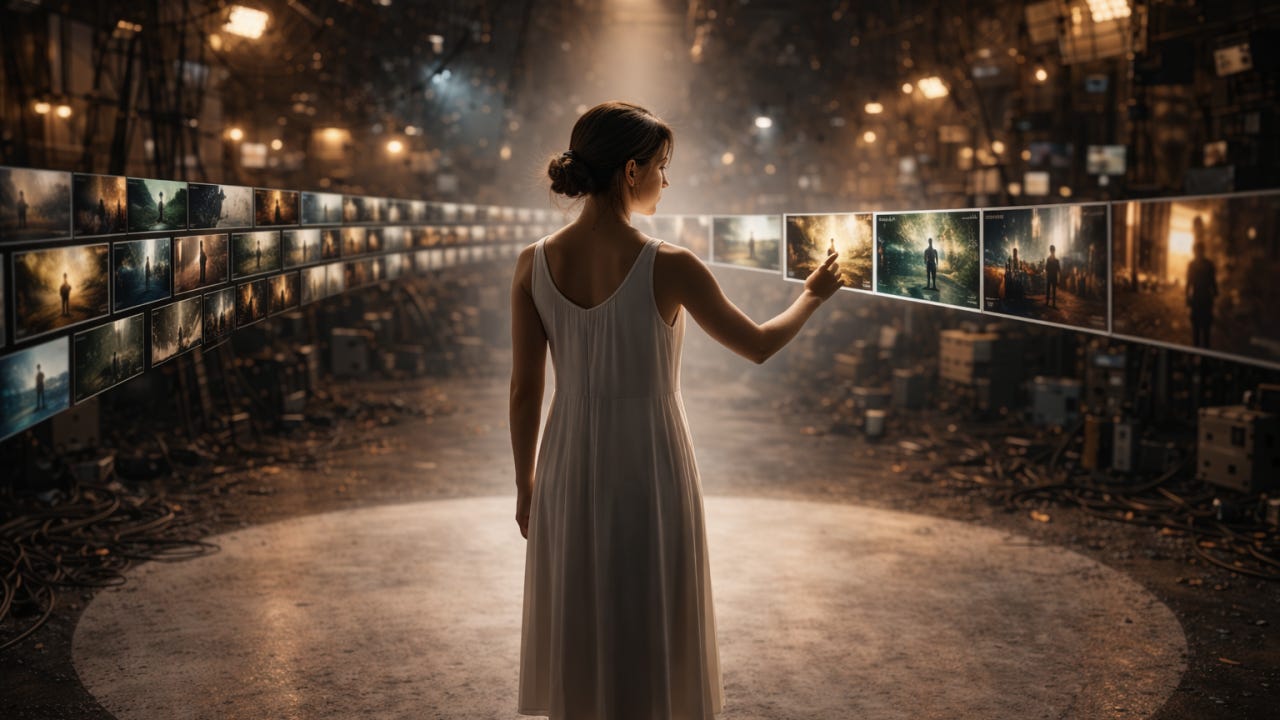
This is why AI should not be imagined as a miraculous solvent that melts away the burdens of production and leaves only creativity behind. It does not eliminate work. It displaces it. Problems that once had to be solved through physical execution now often return as problems of selection, orchestration, correction, and refusal. The labor moves from the world into the process. In one sense, this is a genuine gain. It allows filmmakers to test ideas more quickly, explore variations earlier, and expose weak directions before they harden into expensive commitments. But in another sense, it creates a new danger. When the field of options expands too far, the force of decision can begin to weaken. One no longer has to commit in order to move forward. One only has to continue.
That, more than any melodramatic fantasy of machines replacing artists overnight, is where the deeper problem lies. The risk is not only replacement. The risk is dilution. It is the gradual substitution of necessity with convenience, of intention with probability, of form with an endless cloud of plausible alternatives. Cinema does not become stronger merely because more images can be produced more quickly and more cheaply. Cheaper images are not automatically richer images. Nor does rapid iteration guarantee depth. In fact, the opposite may be true. The easier generation becomes, the more demanding judgment must become in response.
This is precisely where the possibility of a real symbiosis appears. Not in the fantasy of harmony, and certainly not in the surrender of cinema to the logic of the machine, but in a disciplined relationship in which AI expands the field of possibility while filmmaking remains the force that gives possibility form. That, to me, is the only serious basis on which the conversation can move forward. AI is at its weakest when it is used to avoid decisions, and at its strongest when it sharpens them. The value of the tool lies not in replacing authorship, but in making authorship more visible.
A serious filmmaker does not need AI to tell them what to make. What AI can do, when used with intelligence, is reveal weaker options more quickly, test stronger intuitions earlier, and bring processes of exploration and refinement closer together. It can accelerate the route toward a decision, but it cannot decide what carries meaning. That remains a human burden, and perhaps now a heavier one than before. The more possibilities are generated, the more ruthless the act of selection must become. When everything becomes possible, selection becomes the real craft.
This is true across every domain of filmmaking that AI touches. In visual effects, for example, the issue is not whether image generation will automate certain tasks. Of course it will. The more important question is what happens to the deeper function of the craft. High level visual effects was never simply about adding spectacle or polishing surfaces. It has always been about coherence, about making elements produced under radically different conditions behave as though they belonged to a single world. AI may alter the methods by which that coherence is built, but it does not remove the need for the intelligence behind it. If anything, the demand increases. The more visual material can be generated, the more essential it becomes to know what belongs, what holds across time, and what remains faithful to the internal logic of the film. VFX is not the art of making things flashy. It is the art of making things belong.
The same can be said of performance. A synthetic face may imitate expression with increasing fluency, but performance is not reducible to visible emotion. It is not the tear alone, nor the smile, nor the tremor in the voice. It is intention embodied in time, shaped through relation, hesitation, pressure, force, and presence. One may eventually reproduce the outer shell of such moments with astonishing precision, but the question of inner necessity remains. A generated expression is easy. A human moment is not. That does not mean synthetic performance has no place in cinema. It means that its place cannot be defined merely by its visual persuasiveness.
For that reason, I find the language of harmony less useful than the language of discipline. Harmony suggests natural alignment, as though technology and cinema were simply waiting to complete one another. But what is emerging is not harmony. It is a hierarchy of responsibilities. The machine can generate possibilities. Cinema must still decide what they mean. That order cannot be reversed without something essential being lost. The moment filmmaking begins to adopt the value system of the machine, when speed becomes a virtue in itself, when approximation becomes acceptable because it is efficient, when abundance is mistaken for richness, then the danger is no longer that AI has entered the medium. The danger is that the medium has begun to think in the image of its tools.
That is how authorship erodes. Not in one dramatic act of replacement, but through a thousand small concessions to convenience. A process becomes easier, so standards soften. A result becomes faster, so patience begins to look indulgent. A plausible solution appears immediately, so the harder search for the necessary one begins to feel irrational. Craft rarely disappears in a grand collapse. More often, it is priced out of the room.
And yet there is no reason to end in despair, provided one is willing to be exact. Used lazily, AI will flatten. Used opportunistically, it will cheapen. Used without standards, it will flood the field with persuasive emptiness. But used with rigor, taste, restraint, and a clear understanding of what cinema still demands, it may become something more interesting than either utopians or catastrophists tend to imagine. It may become a tool that removes dead weight without removing meaning, that accelerates exploration without dissolving responsibility, and that expands access without abolishing the need for craft.
That, to me, would be the real form of symbiosis. Not a smooth reconciliation. Not a frictionless merger. But a working relationship in which one force produces variation and the other imposes form, one opens possibilities and the other remains accountable for what those possibilities finally become. AI should expand possibility. Filmmaking must still collapse it into meaning.
In the end, the real test is not whether AI can generate images that resemble films. It clearly can. Nor is the real test whether production will become more efficient. It clearly will. The real test is whether filmmakers can hold on to those internal limits that become even more important when so many external limits begin to fall away. When almost anything can be generated, taste matters more. When options multiply, judgment becomes harsher. When the image becomes easier, meaning becomes harder.
That is not a side effect of the new condition. It is the condition itself.
The future of filmmaking will not belong to those who can generate the greatest volume of images, nor to those who mistake technical fluency for artistic authority. It will belong to those who remain capable of choosing, refusing, shaping, and defending form in a moment that constantly tempts them not to. AI may well become an important part of cinema’s future. But it will deserve that place only if it is made to serve the discipline of filmmaking rather than quietly replacing it with the logic of convenience. The future will not belong to those who produce the most images. It will belong to those who can still decide which images matter.In a previous article, I wrote that AI will not kill cinema, but may quietly erode the conditions that make cinema worth defending in the first place. I was not arguing for nostalgia, nor against technology as such. I was trying to describe a real misalignment between two different logics: one rooted in intention, constraint, collaboration, and consequence, the other in speed, scale, approximation, and optimization. That tension has not disappeared. But it is no longer the only question worth asking. The more difficult question is whether AI can enter filmmaking without quietly teaching filmmaking to think like a machine.
If anything, it is where the more difficult story begins.
Because the question is no longer whether AI and filmmaking clash. Of course they do. The more interesting question is whether that clash can be made productive without simply allowing one side to dissolve the values of the other. Put differently, the challenge is not to ask whether AI can enter filmmaking. It already has. The real challenge is to determine under what conditions it can serve cinema without quietly hollowing it out from within.
That distinction matters because much of the public conversation on this subject still moves too quickly between two equally unsatisfying positions. On one side are the evangelists, who present AI as a liberation from friction, cost, and limitation, as though the burdens of production had merely been obstacles standing in the way of pure creativity. On the other are the purists, who treat every technical incursion as a threat to artistic seriousness, as though cinema had always existed in some protected state of human purity. Neither view is convincing, because both are too simple for the moment we are actually in.
Filmmaking has never been pure. It has always been technical, industrial, collaborative, and shaped by its tools. But it has also never been reducible to its tools. That is why the current moment feels so unstable. AI does not simply introduce another instrument into the workshop. It introduces a different operational logic, one that is often indifferent to the very forms of resistance through which artistic intention becomes legible. And yet resistance itself is not something cinema can simply discard.
Friction has always had a deeper function in filmmaking than many contemporary narratives allow. It is not merely an inconvenience. It is often the place where vague intention hardens into a real decision. It is where collaboration stops being an ideal and becomes a negotiation. It is where the limits of time, money, space, bodies, weather, and material force filmmakers to choose what matters most. Remove all friction, and you do not automatically arrive at freedom. You may just as easily arrive at drift.
This is why AI should not be imagined as a miraculous solvent that melts away the burdens of production and leaves only creativity behind. It does not eliminate work. It displaces it. Problems that once had to be solved through physical execution now often return as problems of selection, orchestration, correction, and refusal. The labor moves from the world into the process. In one sense, this is a genuine gain. It allows filmmakers to test ideas more quickly, explore variations earlier, and expose weak directions before they harden into expensive commitments. But in another sense, it creates a new danger. When the field of options expands too far, the force of decision can begin to weaken. One no longer has to commit in order to move forward. One only has to continue.
That, more than any melodramatic fantasy of machines replacing artists overnight, is where the deeper problem lies. The risk is not only replacement. The risk is dilution. It is the gradual substitution of necessity with convenience, of intention with probability, of form with an endless cloud of plausible alternatives. Cinema does not become stronger merely because more images can be produced more quickly and more cheaply. Cheaper images are not automatically richer images. Nor does rapid iteration guarantee depth. In fact, the opposite may be true. The easier generation becomes, the more demanding judgment must become in response.
This is precisely where the possibility of a real symbiosis appears. Not in the fantasy of harmony, and certainly not in the surrender of cinema to the logic of the machine, but in a disciplined relationship in which AI expands the field of possibility while filmmaking remains the force that gives possibility form. That, to me, is the only serious basis on which the conversation can move forward. AI is at its weakest when it is used to avoid decisions, and at its strongest when it sharpens them. The value of the tool lies not in replacing authorship, but in making authorship more visible.
A serious filmmaker does not need AI to tell them what to make. What AI can do, when used with intelligence, is reveal weaker options more quickly, test stronger intuitions earlier, and bring processes of exploration and refinement closer together. It can accelerate the route toward a decision, but it cannot decide what carries meaning. That remains a human burden, and perhaps now a heavier one than before. The more possibilities are generated, the more ruthless the act of selection must become. When everything becomes possible, selection becomes the real craft.
This is true across every domain of filmmaking that AI touches. In visual effects, for example, the issue is not whether image generation will automate certain tasks. Of course it will. The more important question is what happens to the deeper function of the craft. High level visual effects was never simply about adding spectacle or polishing surfaces. It has always been about coherence, about making elements produced under radically different conditions behave as though they belonged to a single world. AI may alter the methods by which that coherence is built, but it does not remove the need for the intelligence behind it. If anything, the demand increases. The more visual material can be generated, the more essential it becomes to know what belongs, what holds across time, and what remains faithful to the internal logic of the film. VFX is not the art of making things flashy. It is the art of making things belong.
The same can be said of performance. A synthetic face may imitate expression with increasing fluency, but performance is not reducible to visible emotion. It is not the tear alone, nor the smile, nor the tremor in the voice. It is intention embodied in time, shaped through relation, hesitation, pressure, force, and presence. One may eventually reproduce the outer shell of such moments with astonishing precision, but the question of inner necessity remains. A generated expression is easy. A human moment is not. That does not mean synthetic performance has no place in cinema. It means that its place cannot be defined merely by its visual persuasiveness.
For that reason, I find the language of harmony less useful than the language of discipline. Harmony suggests natural alignment, as though technology and cinema were simply waiting to complete one another. But what is emerging is not harmony. It is a hierarchy of responsibilities. The machine can generate possibilities. Cinema must still decide what they mean. That order cannot be reversed without something essential being lost. The moment filmmaking begins to adopt the value system of the machine, when speed becomes a virtue in itself, when approximation becomes acceptable because it is efficient, when abundance is mistaken for richness, then the danger is no longer that AI has entered the medium. The danger is that the medium has begun to think in the image of its tools.
That is how authorship erodes. Not in one dramatic act of replacement, but through a thousand small concessions to convenience. A process becomes easier, so standards soften. A result becomes faster, so patience begins to look indulgent. A plausible solution appears immediately, so the harder search for the necessary one begins to feel irrational. Craft rarely disappears in a grand collapse. More often, it is priced out of the room.
And yet there is no reason to end in despair, provided one is willing to be exact. Used lazily, AI will flatten. Used opportunistically, it will cheapen. Used without standards, it will flood the field with persuasive emptiness. But used with rigor, taste, restraint, and a clear understanding of what cinema still demands, it may become something more interesting than either utopians or catastrophists tend to imagine. It may become a tool that removes dead weight without removing meaning, that accelerates exploration without dissolving responsibility, and that expands access without abolishing the need for craft.
That, to me, would be the real form of symbiosis. Not a smooth reconciliation. Not a frictionless merger. But a working relationship in which one force produces variation and the other imposes form, one opens possibilities and the other remains accountable for what those possibilities finally become. AI should expand possibility. Filmmaking must still collapse it into meaning.
In the end, the real test is not whether AI can generate images that resemble films. It clearly can. Nor is the real test whether production will become more efficient. It clearly will. The real test is whether filmmakers can hold on to those internal limits that become even more important when so many external limits begin to fall away. When almost anything can be generated, taste matters more. When options multiply, judgment becomes harsher. When the image becomes easier, meaning becomes harder.
That is not a side effect of the new condition. It is the condition itself.
The future of filmmaking will not belong to those who can generate the greatest volume of images, nor to those who mistake technical fluency for artistic authority. It will belong to those who remain capable of choosing, refusing, shaping, and defending form in a moment that constantly tempts them not to. AI may well become an important part of cinema’s future. But it will deserve that place only if it is made to serve the discipline of filmmaking rather than quietly replacing it with the logic of convenience. The future will not belong to those who produce the most images. It will belong to those who can still decide which images matter.