
When Decisions Become Real

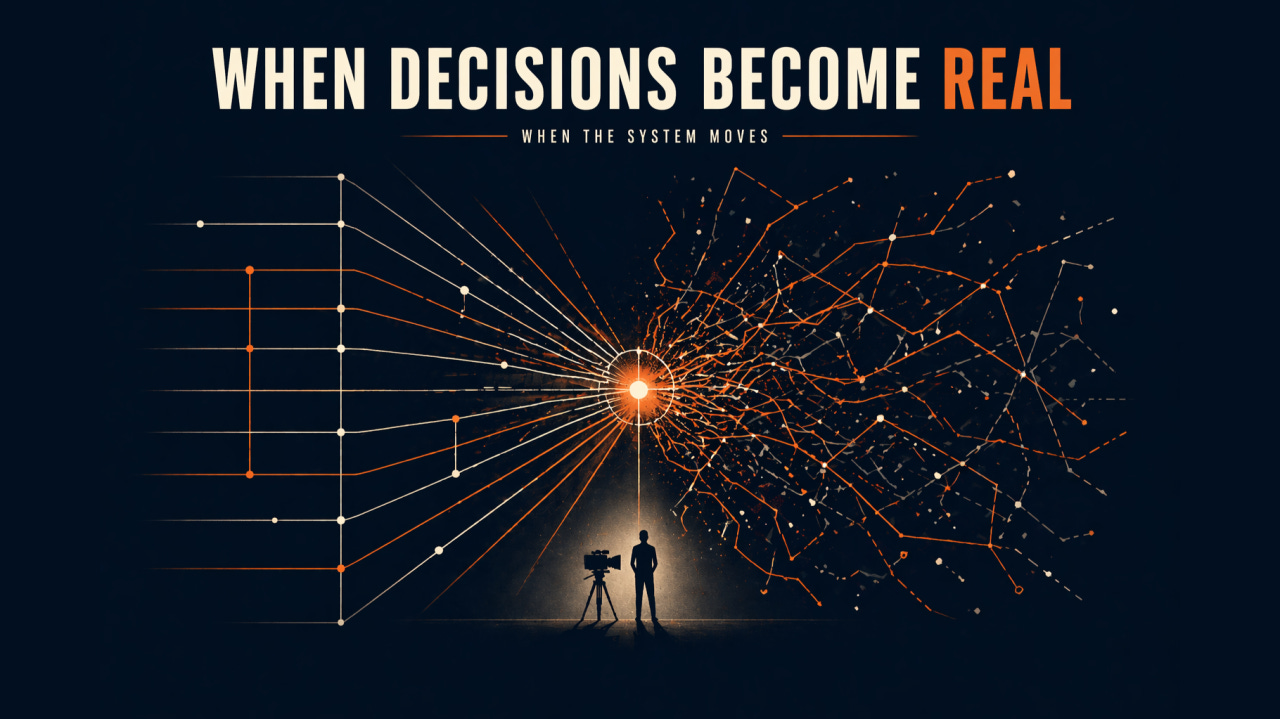
Film production is often described as a chain of decisions, and that is true as far as it goes. Every project is full of choices about casting, locations, camera, budget, schedule, design, workflow, effects, performance, editing, music, distribution, and tone. But the more interesting question is not simply that decisions are made. The more interesting question is when they become real.
At first glance, one might think that a decision becomes real the moment someone in authority announces it. In practice, that is not how film works. A decision does not become real because one powerful person believes it has been settled. It becomes real the moment the production begins organizing around it. And that depends less on hierarchy than many people would like to admit, and much more on consultation, communication, and consequence.
This matters because filmmaking is one of the few creative fields in which decisions very quickly acquire weight beyond the imagination of the person making them. A choice may appear small and still turn out to be expensive, disruptive, or structurally foolish, simply because the person making it does not see all the departments it touches. The distinction between cheap and expensive decisions is therefore often misunderstood. A decision is not cheap because it looks minor. It is cheap only if the people who will bear its consequences have been consulted and have had the chance to say whether it changes anything essential in their work. Ten minutes with the right department heads can save weeks of repair later. That is what makes a decision cheap. Not its size, but the way it is made.
In that sense, no decision in film is ever truly irreversible. One can change almost anything. One can rebuild, rewrite, replace, re edit, repaint, reshoot, or recreate whole shots later with visual effects, digital environments, or other increasingly elaborate means. That is both the beauty and the danger of the medium. Because what is technically reversible may already be economically irreversible. A decision becomes real, then, not when it is impossible to change, but when changing it becomes so expensive that the production can only do so by accepting damage elsewhere.
That is why it is better to think of decision making in film not as a matter of finality, but as a matter of cost, communication, and consequence.
The same applies to timing. People often ask whether decisions are made too early or too late, but that is only half the issue. A decision made early is not in itself a problem. In fact, it is often a strength. The real question is whether it was made with enough knowledge and whether the right people were asked before it was treated as settled. What looks like a timing failure is very often a communication failure. Decisions go wrong not because they were made early, but because they were made early by people with dangerously partial knowledge, or because they were never properly shared with those who would later have to absorb their consequences.
I have seen this repeatedly, especially in technically complex areas. Someone works near a domain long enough to pick up fragments of its logic, and after a while those fragments begin to feel like mastery. A cinematographer who has been around visual effects a number of times starts to believe he can decide like a visual effects supervisor. A producer who has heard enough terminology assumes that they understand the full chain of consequences behind a seemingly simple change. Then decisions are made with confidence that exceeds knowledge, and the damage begins before the first shot is even taken. It is not a question of bad intent. It is a question of half knowledge occupying the place where consultation should have been.
This becomes especially obvious in relation to the phrase every visual effects supervisor has heard far too many times: “We’ll fix it in post.” It is usually said with a kind of misplaced optimism, sometimes even as if it were a compliment, as though visual effects were a magical cleanup department whose purpose is to absorb decisions not taken earlier. But “we’ll fix it in post” is not a solution. It is very often the name of a decision that nobody wanted to make when it was still cheap. The problem does not disappear. It simply travels. And when it returns, it does so as cost, pressure, and compromise.
I once worked on a production where I was effectively pushed out of preproduction because the project was supposedly so raw, authentic, and improvisational that it would not need visual effects at all. The style was meant to be loose, almost documentary in its energy, as if the very act of planning for certain problems would somehow corrupt the truth of the material. After ten episodes had been shot, the rough cuts made it painfully clear that this confidence had been misplaced. What followed was a vast wave of invisible repair work, hundreds upon hundreds of shots that were not visual effects in any expressive sense, but fix ups for decisions not confronted when the project still had the chance to address them structurally. The final result became more or less acceptable, but only by burning an enormous amount of labor that had never been properly budgeted as part of the original thinking. The delayed decision did not vanish. It simply returned later in a more expensive form.
This is one of the central truths of film production. Decisions delayed are rarely decisions avoided. More often, they are decisions transferred into a part of the process where they become harder, costlier, and more destructive.
The opposite mistake also happens, though I would define it differently than people usually do. I do not think the deepest problem is deciding too early. The real problem is deciding without enough consultation and then treating the decision as fixed. In film, one always has to make certain choices in advance. One has to choose actors, locations, schedules, crew structures, workflows, financial scales. That is not unusual. The issue is whether such choices were made with adequate awareness of what they will do to everyone else. If not, then the production may mistake decisiveness for clarity, when in reality it is merely making itself vulnerable earlier.
This is one reason virtual production is so often misunderstood. People say that virtual production forces earlier decisions, but I think that formulation is slightly wrong. Film has always required early decisions. One always had to decide on cast, location, studio versus exterior, scale, and method long before the day of shooting. What virtual production does is not simply force decisions earlier, but allow them to become better informed earlier. It expands the decision space in preproduction by making consequences more visible sooner. Previsualization, technical testing, spatial planning, and world building can all help a production decide with more knowledge than it would otherwise have. The mistake is to think that virtual production begins only once one stands in front of an LED wall. In truth, the wall is only the visible result of a much larger preproduction intelligence.
And even there, the fantasy of total rigidity is misleading. A virtual production setup does not automatically mean that everything is carved in stone once the shoot begins. One can still make decisions on set and alter environments. But if flexibility is desired, it has to be anticipated. One has to say where flexibility is needed and at what level the system must remain responsive. In other words, even flexibility must be prepared through communication. That is what makes the decision architecture stronger, not weaker. It is not about abolishing change, but about knowing where change can still happen meaningfully.
If decisions in film depend so heavily on communication, one must also ask who really decides. Officially, the answer is often simple. The director decides. Or the department head decides within their domain. Or the collaboration between certain creatives produces a shared decision. In reality, that remains true only up to the point where money becomes decisive, which is to say, up to the point where the decision begins to matter materially. Once costs rise, another level enters the room, whether visibly or invisibly. The producer, the financier, the bank, the hard boundary of available resources. Money does not always speak directly, and it is often polite enough to let others preserve the appearance of choice, but it remains the force that sets the real perimeter within which decisions can become real.
That is not cynicism. It is production reality. Many decisions appear to belong to the director, but the director often chooses within boundaries that have already been financially defined. Creative decisions can be shared until they begin to cost. Then the sword of budget hangs over them, and the structure of power becomes much clearer. In an ideal world, domain based decisions would remain genuinely shared among those with the best knowledge of their consequences. In practice, they remain shared until they collide with resource limits, and then economics reveals itself as the final horizon.
Pressure intensifies all of this. Under pressure, decision quality becomes extremely uneven. Some people become sharper, more focused, and more decisive. Others become emotional, defensive, or erratic. The least useful thing that can happen in such moments is the conversion of urgency into blame. Film sets are full of passionate people, and passion under time pressure can turn ugly very quickly. The moment a discussion shifts from facts and options toward the question of who is at fault, the production begins burning the one thing it cannot buy back, namely time. The minutes spent allocating blame are minutes not spent solving the problem.
This is why the best producers, and especially the best line producers, are so valuable. Their gift is not simply toughness, nor even financial discipline. It is the ability to cut through emotional fog and reduce a problem to facts, options, and solutions. They understand that on a set, decisions do not have the luxury of philosophical delay. They have to be made in the present, under conditions of incomplete control, and still carry enough clarity to move the production forward. Good line producers know that while creative people may be deeply personally invested in a problem, the work itself needs a faster and colder form of decision logic in order to survive.
So what is the real disease of decision making in film? I do not think it is lack of commitment, and not even primarily bad timing. It is the habit of making decisions in small informal clusters, between a few people over coffee or at the food truck, without consultation and without communication to the wider system afterward. That is where productions are quietly damaged. Not because someone made a choice, but because they made it in the wrong communicative form. A decision that is not consulted is already weak. A decision that is not relayed is not really a decision at all, only a private assumption with public consequences.
That is the uncomfortable truth. Decisions do not usually destroy productions because they are bold, late, early, or difficult. They destroy productions because they are made without the right people in the room and then allowed to travel through the system without being properly shared. And when that happens, every later department pays for the illusion that a private conversation was enough to settle something real.
This is why the real currency of film production is not simply ideas, money, or tools. It is decisions that have been properly made. Decisions that were consulted, communicated, understood, and allowed to become real in the only way that matters, namely through a system that actually knows what has been decided and can organize itself accordingly.