
The Bolex Parable
Why Filmmakers Do Not Buy Your Future So Easily

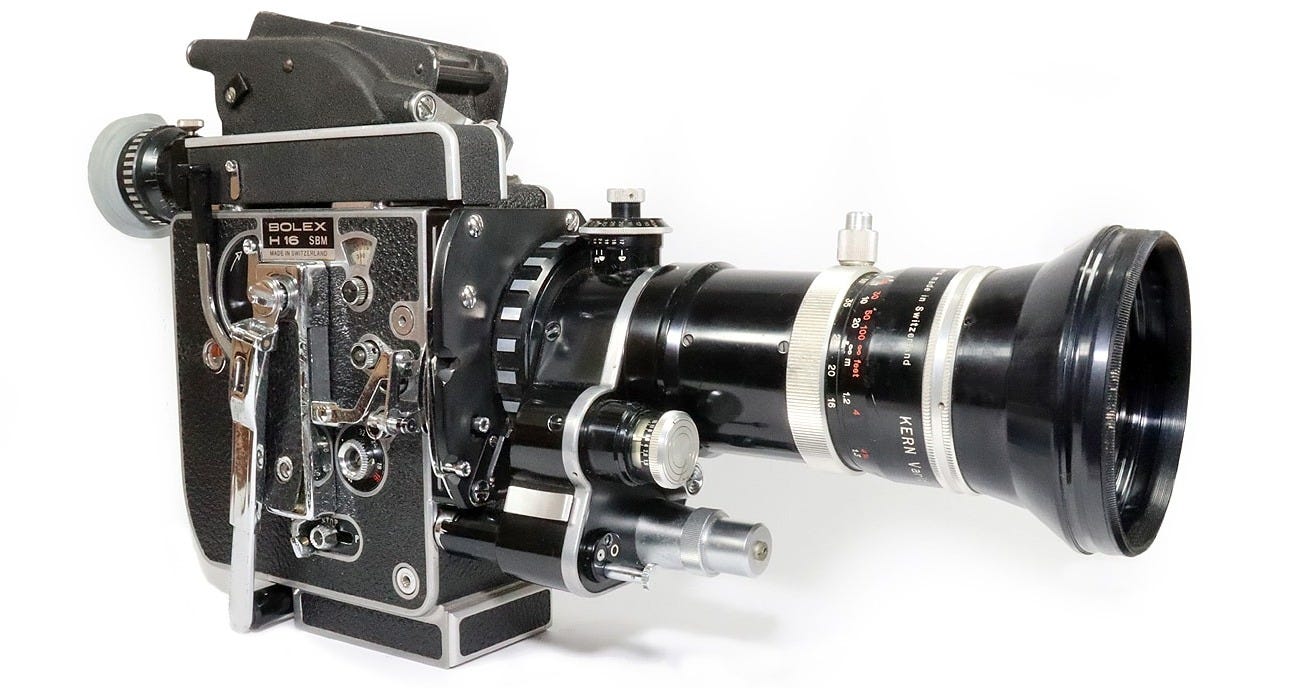
I grew up in a world where machines had weight, where buttons had consequences, where your mistakes were not a undo shortcut but a real cost. I am trained on analog film technology, and I still love it with a stubborn loyalty that annoys certain people at dinner parties. I also collect Bolex cameras, which means I own multiple variations of the same basic idea, built decades apart, and I still get that quiet thrill when I pick one up. The first time you feel the spring motor tension in your hand, you understand something that a spec sheet can never teach: this tool wants to work with you.
Now here is the part that should bother every modern technology evangelist in filmmaking. The Bolex was probably not the best 16 mm camera you could buy at many points during its long life. It was not the quietest. It was not the most advanced. It was not the most “industry standard” in the classic studio sense. And yet it became one of the most successful and enduring cameras in the entire 16 mm universe. It stayed culturally alive for decades, and even today, when these cameras are fifty, sixty, seventy years old, they are still not just admired. They are used. They are desired. They are repaired. They are loved.
That is not nostalgia. That is a lesson.
A camera for people who actually make things
If you have never heard of a Bolex, picture a compact Swiss made 16 mm motion picture camera built around a simple, almost stubborn principle: independence. Many Bolex models run on a spring wound motor. You wind it. You shoot. No battery panic. No charger. No cable. No “we cannot roll because the firmware is updating.” Just a mechanical promise that, if you do your part, it will do its part.
This design choice shaped everything about how the camera behaves in the world. It favors short takes and deliberate thinking. It rewards preparation and rhythm. It is small enough to live with. It can be carried without a small procession of cases and assistants. It invites the solo filmmaker, the student, the documentarian, the animator, the experimental artist, the person who wants to test an idea today and not next week after a technical meeting.
That last point matters more than people admit. Many tools fail not because they are incapable, but because they demand a ceremony before they allow you to begin. The Bolex is the opposite of ceremonial. It is a working camera that feels like it was designed by someone who had actual things to shoot and not enough time to impress anyone.
The paradox of “not the best” and still winning
When a tool is not the best in absolute terms but becomes massively successful, it usually means it won a different competition. Not the competition for peak performance, but the competition for daily survival.
In filmmaking, peak performance is seductive. It creates myths. It creates posters. It creates the kind of online discourse where people compare numbers, charts, and lab tests as if art were a tournament in controlled conditions.
But daily survival is what decides what tools people keep. Daily survival is what happens when you are tired, underpaid, under time pressure, surrounded by compromises, and still trying to get something honest onto a strip of film. In that world, the best tool is the one that reduces friction between intention and result.
The Bolex reduced friction.
It did not require a large infrastructure to justify itself. It did not require a big crew to be meaningful. It did not require you to be a certain kind of person with a certain kind of access. It was serious, but it was reachable. It was precise, but it was not precious. It had limitations, but the limitations were understandable, and that is the key difference between a limitation and a trap.
A trap is a failure mode you discover too late, at the worst moment, with no clean way out. A limitation is something you can plan around. Professionals can live with limitations. Professionals do not forgive traps.
Why it stayed alive for so long
Some tools survive because they keep changing. The Bolex survived because it did not need to.
Over decades there were variations, improvements, different features, different refinements, but the core mental model stayed stable. The camera still felt like itself. That stability created something more valuable than innovation: trust.
Trust is not a marketing claim. Trust is a physical memory in your hands. It is the confidence that the tool behaves tomorrow the way it behaved yesterday. It is the feeling that your learning is not disposable. It is the sense that the tool will not punish you for investing time in mastery.
And once a tool becomes teachable, it becomes transmissible. Film schools adopt it. Teachers build lessons around it. Technicians learn how to service it. A second hand market thrives. A shared culture forms around it. The tool becomes a language. People can talk about it without translating every sentence. That is how a camera becomes more than a camera. It becomes a small institution.
I have seen claims about very large numbers of Bolex cameras in use historically, sometimes around the two hundred thousand range. I cannot verify that as an audited sales figure, and some of those claims come from marketing or collector contexts, so I treat them as suggestive, not definitive. But even without exact numbers, the scale is obvious in the real world: the cameras are everywhere in archives, schools, collections, and resale markets, and crucially, they still have a living repair culture. A tool does not develop that kind of ecosystem by accident.
The modern mirror: usability beats technical excellence more often than we want to admit
This is where the Bolex becomes painfully relevant to AI and virtual production.
We are living through an era where filmmaking tools promise miracles and deliver meetings. The demos look like cinema. The day on set looks like IT support. The pitch says “creativity unleashed.” The reality says “log in, update, calibrate, re calibrate, and pray the network behaves.”
I am being provocative on purpose, because the industry needs a little honesty. The people selling new tools often measure success in spectacle. Filmmakers measure success in momentum. Spectacle is what happens when everything goes right. Momentum is what keeps going when something goes wrong.
The Bolex is a momentum tool. It is not the ultimate performance ceiling. It is a low friction floor. It gets you rolling. It keeps you rolling. It makes the act of filming feel possible.
AI tools and virtual production systems often have the opposite shape. Their ceiling is jaw dropping. Their floor is exhausting. And in a production environment, the floor matters first.
Here is the blunt rule that many technology roadmaps ignore: a tool is only as good as the moment it fails. If failure destroys the day, you will not be trusted again. If failure is legible and recoverable, you will be tolerated, then accepted, then maybe loved.
Analog tools often fail in ways that are legible. You hear the motor. You feel the resistance. You see the film path. Digital systems often fail in ways that are invisible until the damage is done. And AI systems add another layer: failure can look like success. You can get an output that seems plausible, even beautiful, and still be wrong in the ways that matter. Wrong continuity. Wrong intent. Wrong authorship. Wrong ethics. Wrong licensing. Wrong provenance. Wrong meaning.
Filmmakers are not allergic to technology. They are allergic to hidden costs and invisible failure modes.
Trust versus constant evolution
There is another reason the Bolex story matters right now. It represents a model of technological time that we have almost lost: continuity.
Many modern tools in filmmaking evolve through rapid cycles. Updates arrive constantly. Interfaces shift. Features change names. Pipelines break. Tutorials rot. Yesterday’s expertise becomes today’s confusion. Teams spend energy relearning instead of making.
This is often presented as progress, but in production culture it feels like disrespect. Not because filmmakers are conservative, but because filmmaking is already hard. The job is not to keep up with tool churn. The job is to deliver meaning, under pressure, with imperfect conditions, through collaboration.
A trusted tool honors the user’s investment. It does not treat mastery as a temporary subscription.
That is why old cameras can remain popular long after their technical limits are surpassed. Not because they are secretly superior, but because they are stable partners. They hold still while you grow. They do not demand that you chase them.
When I pick up a Bolex, I am not just holding engineering. I am holding a contract: learn me once, and I will not betray you next month.
Imagine what AI and virtual production would feel like if they offered that kind of contract.
Why film professionals are a tough market, and why skepticism is healthy
Now we get to the social part, the part that technology people often misunderstand.
Film professionals are a tough market because filmmaking is a high burn, high interdependence, high accountability environment. When a new tool fails, it does not only fail privately. It fails in front of a crew. It fails in front of a client. It fails inside a schedule that cannot be negotiated with your optimism.
Skepticism is not stubbornness. It is a survival instinct refined by experience.
Every crew member has lived through at least one “miracle tool” that arrived with grand promises and left behind a trail of overtime, broken workflows, and awkward apologies. Every department has its own version of this story. The camera department. The color pipeline. The VFX pipeline. Sound. Editorial. Production. Everyone remembers a day when the new thing ate the day.
So when AI and virtual production arrive with evangelists who talk like missionaries and update like teenagers, professionals do what professionals should do. They ask hard questions. They demand reliability. They worry about training time. They worry about integration. They worry about what happens when the tool is abandoned by the vendor. They worry about whether the output is controllable, repeatable, and ethically defensible.
And there is a deeper layer that is not technical at all.
Many tech narratives have been framed as replacement narratives. Even when the tool can be used responsibly as part of a larger authored workflow, the cultural messaging around it often sounds like an eviction notice. Filmmakers do not react badly because they are “emotional.” They react badly because you are poking at identity, authorship, and the dignity of craft.
Cinema’s value is not only efficiency. Cinema’s value is human presence, collaboration, taste, risk, and accountability. When a technology positions itself as a way to remove those human burdens, it is not surprising that the people who carry those burdens for a living get suspicious.
Again, skepticism is not anti innovation. Skepticism is the immune system of a profession that cannot afford magical thinking.
What the Bolex teaches new technologies, if they are willing to listen
If I had to compress the Bolex lesson into a single thought, it would be this: the market rewards tools that protect creative energy.
The Bolex protected creative energy by being understandable, dependable, and stable. It gave people a clear relationship between action and result. It did not demand a committee to be used. It did not turn every shoot into a technical performance review.
AI and virtual production can earn the same kind of long life, but only if they stop obsessing over ceilings and start respecting floors.
They need to become tools that behave like instruments. Predictable. Legible. Repairable in a practical sense. Transparent in their limits. Stable in their interfaces. Calm in their update cycles. Honest about their failure modes. Clear about provenance, authorship, and responsibility.
Most of all, they need to learn the Bolex attitude: a tool should not ask the artist to trust it. A tool should behave in a way that makes trust inevitable.
When I collect Bolex cameras, I am not collecting museum objects. I am collecting a philosophy of toolmaking. I am collecting the idea that a camera can be a partner rather than a platform.
If your technology requires belief, it is not ready. Filmmakers do not run on belief. They run on tests, scars, and deadlines.
The Bolex did not become enduring because it was perfect. It became enduring because it was dependable enough to become intimate. It earned a place in hands, not in decks.
So when I hear AI and virtual production described as inevitable revolutions, I do not argue with the potential. I argue with the arrogance. The future is not adopted because it is announced. It is adopted because it behaves well on a bad day.
And maybe that is the real reason old machines keep winning our affection. They do not promise to change everything. They simply show up, again and again, and let you make something that lasts.
#Filmmaking #VirtualProduction #AI #GenerativeAI #Cinematography #VFX #AnalogFilm #Bolex #Workflow #CreativeTools #Craft #Authorship #Innovation