
AI marketers: you are doing it wrong!

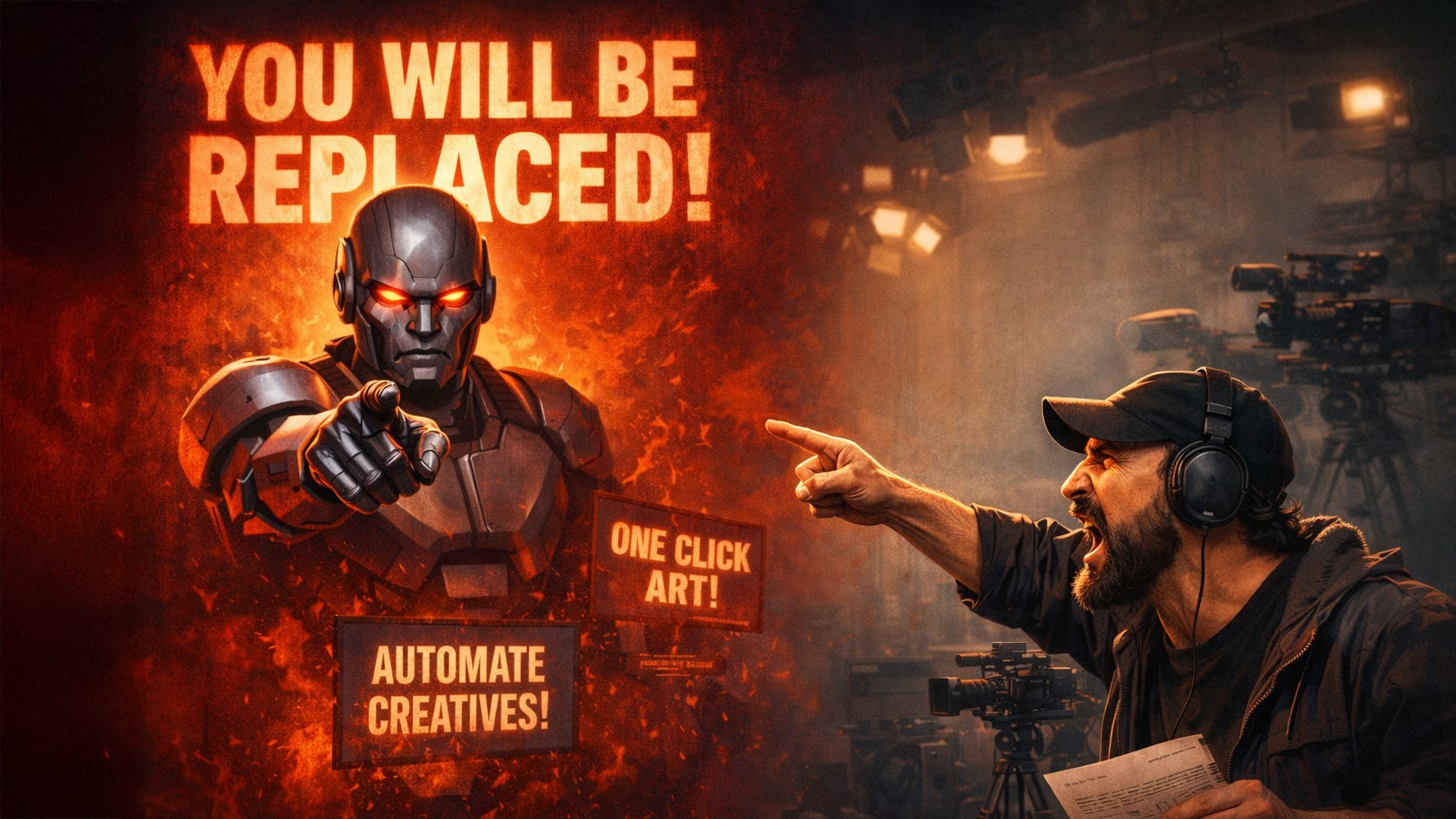
You keep walking into rooms full of creatives and filmmakers with the emotional intelligence of a broken smoke alarm. Loud, repetitive, and convinced that panic is a strategy.
Then you act surprised when people recoil.
Here is the part you do not want to hear. Your biggest problem is not model quality. Your biggest problem is that you do not understand what a creative process is, how it feels from the inside, and why your messaging reads like an eviction notice.
You are not selling a tool. You are poking at identity.
“You will be replaced” is not a sales argument
It is a threat dressed up as insight.
And threats do not convert thoughtful professionals. They trigger immune systems. They trigger contempt. They trigger the very reaction you complain about later: “creatives are so emotional about AI.”
Yes. Because you made it personal.
You framed your product as a weapon pointed at the buyer’s dignity, then asked for their credit card.
If your pitch is “adopt this or disappear,” you are not marketing, you are doing a loyalty test for sociopaths. The buyer hears only one thing: “You are expendable.” And once someone believes you see them as expendable, they will never trust you near their work, their clients, or their reputation.
This is where you lose filmmakers in particular. Film is not a solo sprint. It is a chain of responsibility. The director protects meaning. The producer protects risk. Editorial protects truth of performance. Production design protects coherence. Sound protects emotion. Every department protects something fragile that cannot be measured on a dashboard. When you swagger in with replacement talk, you tell them you do not respect the fragile parts. You respect only throughput.
You are speaking the language of a factory at people who build meaning.
And meaning is the product.
Why your messaging alienates creatives
A creative process is not a vending machine where you insert prompts and receive art. It is messy, iterative, social, political, and full of judgment calls that are hard to justify in spreadsheets.
A filmmaker does not want “more outputs.” They want fewer outcomes that survive contact with taste, context, continuity, budget, approvals, and the brutal reality of deadlines.
When you sell “one click” anything, you signal that you have never sat in a review where everyone is tired, the client is nervous, legal is hovering, and one small inconsistency can trigger a week of rework. In that room, speed is not the core fear. Unreliable results are.
So stop fetishizing speed like it is virtue by itself. Speed without control is just a faster way to crash.
If you want to sell AI to creatives, you must stop marketing like a tech bro and start behaving like a production partner.
Now let us talk about what you should do instead.
Sell a wedge, not a religion
Your “AI for everything” story is a red flag. It communicates that you are not solving a real production problem. You are selling a worldview.
Filmmakers do not buy worldviews. They buy relief from specific pain.
Pick one moment in the workflow where friction is constant and expensive, then become unreasonably good at that. That is how adoption happens in production environments. Not with grand manifestos, but with one annoying bottleneck that finally disappears.
The provocative truth is that your broad positioning is not ambitious. It is lazy. It saves you from choosing, so the market chooses for you, and it chooses someone else.
Sell control, not content generation
Creatives are not allergic to AI. They are allergic to losing authorship while being held responsible for the outcome.
So the product you are really selling is control surfaces. Constraints. References. Brand locking. Style bibles. Versioning. Reproducibility. Review notes that stick to outputs like receipts.
In film, repeatability is not a nice feature. It is oxygen. If a result cannot be reliably recreated, it cannot be trusted in a pipeline.
This is where most AI marketing sounds like it was written by someone who has never delivered anything to a client. “Look at this wild variation.” Great. Now show me the exact same result next week when the director changes one word and legal asks for provenance.
If you cannot do that, you are not selling a tool for professionals. You are selling a toy that will be smuggled into the workflow and quietly blamed later.
Make ownership and provenance painfully clear
If you want filmmakers to adopt AI in real work, you must treat legal clarity as part of the creative experience. Not as a separate PDF nobody reads.
Be explicit about what happens to their data. Be explicit about retention. Be explicit about whether their material trains anything. Be explicit about what can and cannot be licensed, and what is user supplied. If something is unknown, say it is unknown.
Do not hide behind vague “we respect creators” language. That reads like a confession.
In production, the question is simple: can I ship this without destroying trust with my client, my team, and my future self. If you cannot help them answer that, you do not have a professional product, no matter how good the outputs look on your homepage.
Integrate into real workflows, not your fantasy dashboard
Stop building yet another hub. Filmmakers already have too many places where work goes to die.
They adopt tools that live where they already are. That means integrations, plugins, and handoffs that respect existing habits. If your tool forces a new ritual, you are asking for cultural change. Cultural change is expensive. Most teams will not pay it.
Your product should feel like it belongs in the pipeline, not like a detour that needs permission.
Speak in shots and deliverables, not features
Your feature list is not persuasive. It is a confession that you do not know what success looks like for the buyer.
Show a real deliverable. A look board that survives a creative director. A pitch deck visual language that stays coherent across revisions. A script breakdown aid that reduces mistakes. A transcript workflow that makes editorial faster without hallucinating. A localization variant pipeline that does not break approvals.
You sell credibility by showing that you understand what “done” means in a production context.
Stop pretending “department” is a detail
Filmmakers are not one market. They are a coalition of roles with different incentives and fears.
If you pitch the same promise to editorial and production design, you will sound like you are not serious. Each department has its own definition of risk and value. Your messaging should respect that reality rather than flatten it into a generic “creator” blob.
The fastest way to be ignored is to speak in generic terms to people who do specific work.
Make security boringly solid
If you want studio trust, your security posture cannot be vibes based. It must be concrete enough that a cautious producer can defend the decision internally.
Confidentiality is not a footnote in film. It is a condition of employment. When you treat it like an enterprise upsell, you tell the market you do not understand the stakes.
Price like production, not like consumer subscriptions
Production is spiky. Freelance heavy. Project based. Your pricing should fit that reality.
If your model punishes teams for trying you during a burst period, you are selecting for hobbyists, not professionals. And then you will wonder why your “creator” customers churn.
Enablement beats hype
Here is the uncomfortable part. Many people fail with AI tools not because they are stupid, but because the product teaches nothing and the marketing lied about effort.
If you want adoption, you need workflow playbooks that turn the first hour into something usable for tomorrow’s meeting. Templates tied to real deliverables. Onboarding that starts with the buyer’s constraints, not your model’s capabilities.
Professionals do not want magic. They want reliability and a path to competence.
Ethics belongs in the product, not in your slogan
If you are serious about the creative market, build safeguards into defaults. Provenance options. Disclosure tools. Consent aligned datasets where possible. Clear guidance on what is safe, what is risky, and what is unknown.
Do not moralize. Protect the user.
Because in the end, the user is the one who carries the consequences when something goes wrong.
The punchline you have been avoiding
You can have a genuinely useful AI product and still fail because your marketing is disrespectful.
You are not being rejected because creatives are irrational. You are being rejected because your story tells them you do not value authorship, you do not respect craft, and you do not understand responsibility.
So here is the corrective.
Stop selling fear. Stop selling replacement. Stop selling “one click” fantasies that collapse the moment a real pipeline touches them.
Sell what professionals actually need: control, repeatability, integration, clarity, and trust.
Then prove it with one short demo that looks like production. Constraints in. Iterations. Selection. Handoff into the tools they already use. Final output that survives scrutiny.
Do that, and you will not need to shout.
Because for filmmakers, the best sales argument is not “you will be replaced.”
It is “you will stay in charge.”