
AI in Visual Effects
Past, Present, and the Path We Choose

The Buzzword That Isn’t New
Artificial intelligence is the most fashionable term in creative technology today, yet for those who have worked in visual effects for any length of time, it is nothing new. AI has been embedded in production pipelines for years, though it used to go by less glamorous names such as procedural automation, statistical analysis, and machine learning. The real shift is not that AI has suddenly entered the VFX space, but that it has moved from being a hidden process inside specialist software to a visible, headline-making creative partner. That visibility, combined with the explosion of generative AI tools, has brought a mix of excitement, hype, and concern to an industry that thrives on innovation but is built on the craft of human artistry.
Before “AI” Was Cool: The Quiet Years
The history of AI in VFX is long, even if we did not call it AI at the time. In the late 1990s and early 2000s, match-moving and camera-tracking tools began incorporating algorithms that could “learn” from frame sequences, predicting how a camera moved in three-dimensional space. This replaced hours of manual point tracking and made complex shots feasible on tighter schedules. Rotoscoping also evolved from painstaking frame-by-frame mask drawing to semi-automated edge detection systems that could follow contours and adapt to motion changes.
Physics simulation engines, like those used for cloth, water, smoke, and explosions, were early forms of algorithmic intelligence. They were rule-based, not generative, but they mimicked the behaviour of the physical world without requiring artists to animate each vertex by hand. Procedural crowd systems, such as Massive used in The Lord of the Rings, created thousands of unique agents whose movements reacted to each other’s positions and actions in ways that felt organic. These were not neural networks, but they were precursors to the autonomous behaviour now associated with AI.
By the 2010s, deep learning began to influence VFX in less visible ways. Render denoisers like NVIDIA’s OptiX used trained models to identify and remove noise from Monte Carlo renders in seconds rather than hours, slashing render farm costs. Image upscaling tools based on convolutional neural networks (CNNs) began appearing in restoration workflows, reviving old footage with new levels of detail. These developments happened largely in the background, integrated into the everyday tools of the trade.
The Present: AI as a Front-of-House Tool
The current wave of AI is different in one crucial respect: it is no longer hidden inside the software. It is now a direct creative interface. Concept artists can generate dozens of fully rendered images in minutes using platforms like Midjourney, DALL·E, or Stable Diffusion, exploring variations in style, lighting, and mood without starting from a blank canvas. Previsualisation teams can take grey-box 3D layouts and feed them into generative image models that return atmospheric, textured frames that convey a director’s intent to clients and stakeholders.
Machine learning now drives advanced rotoscoping in Nuke’s CopyCat node, Adobe’s Roto Brush 2, and DaVinci Resolve’s Magic Mask, which can track people and objects through complex motion. AI-powered cleanup tools can remove unwanted props, markers, or even entire moving vehicles from a shot with convincing results. Neural radiance fields (NeRFs) allow for the quick capture of real-world locations, creating navigable 3D environments from a few minutes of video footage -a breakthrough for set extensions and virtual production. AI-based motion capture systems such as Move.AI or Rokoko Vision now make it possible to animate characters from a single camera feed, without the need for marker suits or expensive capture volumes.
In restoration and remastering, AI upscalers like Topaz Video AI are being used to bring old productions into the 4K or even 8K era, recovering detail and interpolating missing frames. While none of these tools can yet replace an entire VFX department, they can remove weeks of labour from the schedule and free up teams to focus on the shots that demand true creative problem-solving.
The Limits: What AI Still Cannot Do
Despite the hype, AI has not mastered the full complexity of VFX production. Maintaining visual consistency across a sequence of shots remains a major hurdle for generative models. What works for a single still frame often falls apart when characters need to move, props need to be reused, and camera angles need to match precisely.
Complex compositing challenges still require human judgment. An AI can guess at how to blend a CGI element into a live-action plate, but it cannot fully grasp the narrative and emotional intent behind a director’s choice of lighting or lens. Continuity errors, stylistic mismatches, and the subtle imperfections that make something feel real are still best handled by experienced artists.
Most importantly, AI cannot yet interpret the evolving demands of a director’s vision over months of post-production. While it can imitate styles, it does not understand why those styles matter to the story, and it cannot respond to intangible creative notes such as “make it feel more unsettling, but still beautiful.”
The Future: Likely Developments
In the short term, AI will continue to automate repetitive tasks. Rotoscoping, background cleanup, and simple compositing will become near-instant for most shots. Compositing software will offer AI-generated node graphs based on a text description of the desired outcome. Virtual production will integrate AI-driven set extensions that adapt in real time to camera movement, changing lighting conditions automatically to match mood and continuity.
Mid-term advances may see AI generating entire asset libraries from a single style sheet, maintaining visual coherence across environments, props, and costumes. Fully automated previs, where a director can verbally describe a scene and watch it materialise in a real-time engine, is on the horizon. AI-assisted editing tools may become capable of delivering a first assembly that respects the emotional beats of a script.
In the long term, there is potential for AI agents to manage entire post-production workflows — from asset tracking to quality control — operating in the background as an invisible production coordinator. But even here, the success of such systems will depend on human oversight to ensure artistic intent is preserved.
The Choice: What We Want and What We Do Not
AI’s role in VFX is not a matter of technological inevitability but of human choice. The industry should embrace AI for the tasks that free artists from drudgery, shorten iteration cycles, and democratise access to creative tools. Removing the most tedious aspects of rotoscoping or match-moving does not diminish the artistry of a compositor; it amplifies it by giving them more time to refine the details that make a shot sing.
However, the temptation to replace entire creative roles with automated systems must be resisted. The erosion of authorship, the devaluation of craft, and the misuse of artists’ work as unlicensed training data are threats that could undermine both the quality of the work and the sustainability of the profession. AI-generated filler content might be cheap, but it risks flooding the market with visuals that lack depth, originality, and cultural relevance.
What we want is an AI that serves as a collaborator, not a competitor, but a partner in the creative process that respects human authorship, credits contributions transparently, and is trained on ethically sourced data. What we do not want is an AI that turns artistry into a commodity and replaces thoughtful craft with algorithmic pastiche.
The Path We Choose
AI has already transformed VFX, both in visible and invisible ways. It has made processes faster, cheaper, and in some cases more accessible. But it has not replaced the deep human understanding of narrative, emotion, and cultural context that lies at the heart of visual storytelling. As the tools evolve, the real question is not what AI will be able to do, but how we decide to use it. The technology will keep advancing. The creative choices — and the responsibility for them — remain ours.
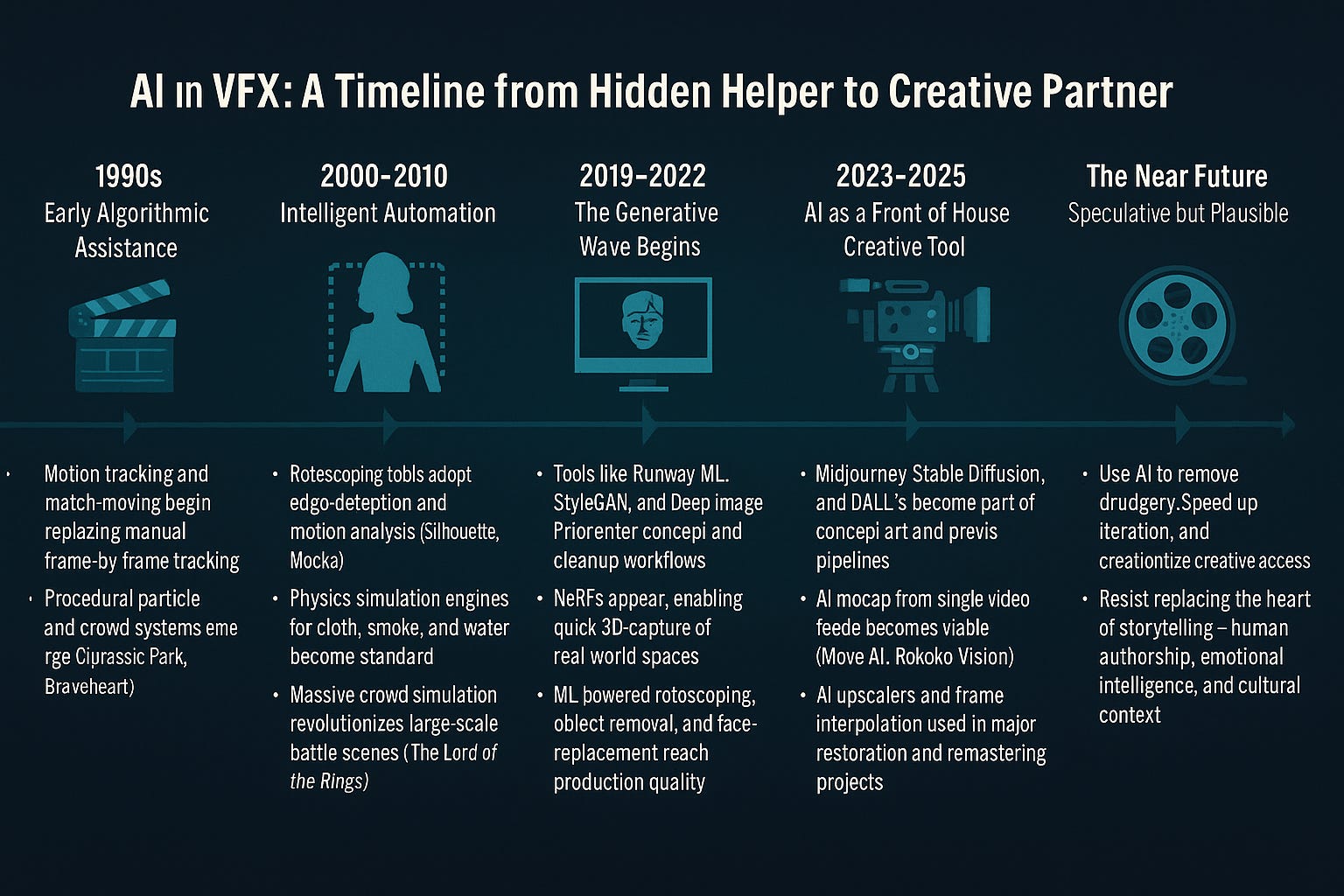
AI in VFX: A Timeline from Hidden Helper to Creative Partner
1990s — Early Algorithmic Assistance
Motion tracking and match-moving begin replacing manual frame-by-frame tracking.
Procedural particle and crowd systems emerge (Jurassic Park, Braveheart).
2000–2010 — Intelligent Automation
Rotoscoping tools adopt edge-detection and motion analysis (Silhouette, Mocha).
Physics simulation engines for cloth, smoke, and water become standard.
Massive crowd simulation revolutionises large-scale battle scenes (The Lord of the Rings).
2010–2018 — Machine Learning in the Background
Deep learning render denoisers like NVIDIA OptiX speed up final frames.
CNN-based image upscaling and restoration enhance archival footage.
Early AI mocap from limited sensors starts appearing in indie workflows.
2019–2022 — The Generative Wave Begins
Tools like Runway ML, StyleGAN, and Deep Image Prior enter concept and cleanup workflows.
NeRFs appear, enabling quick 3D capture of real-world spaces.
ML-powered rotoscoping, object removal, and face-replacement reach production quality.
2023–2025 — AI as a Front-of-House Creative Tool
Midjourney, Stable Diffusion, and DALL·E become part of concept art and previs pipelines.
AI mocap from single video feeds becomes viable
AI upscalers and frame interpolation used in major restoration and remastering projects.
The Near Future — Speculative but Plausible
AI-driven previs integrated directly into virtual production stages.
Style-consistent asset generation across environments, props, and characters.
Automated first-pass edits shaped by script analysis and director notes.
The Choice Ahead
Use AI to remove drudgery, speed up iteration, and democratise creative access.
Resist replacing the heart of storytelling — human authorship, emotional intelligence, and cultural context.